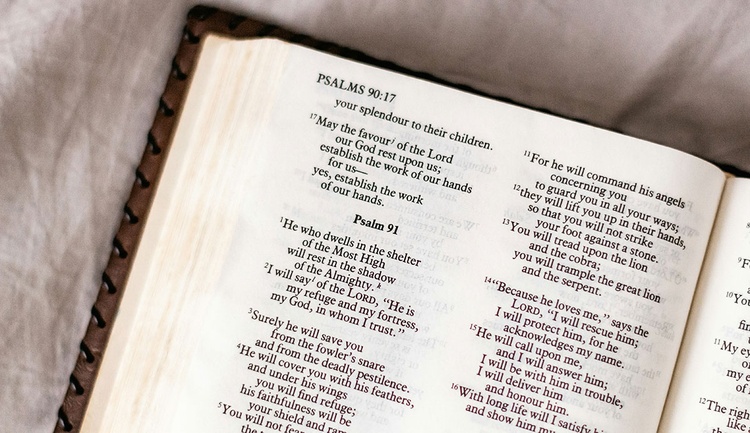

During her four-year cancer battle, Nanci and I prayed together every night, asking God to remove the cancer. We asked Him to perform a miracle, and if He didn’t do that, to use the medical means over which He is sovereign to save her life. We understood that healing was never a certainty, and also knowing full well that sometimes He chooses to heal and sometimes He doesn’t, and even when He does the healing is temporary, and death always comes.
“For death is the destiny of every person, and the living should take this to heart” (Ecclesiastes 7:2). When doctors told us Nanci was going to die, she told me, “We always knew that, we just didn’t know when, and we still don’t.”
I don’t regret all those prayers for a moment. I believe it was right to ask, and I know we were sincere in our asking. God didn’t answer as we hoped He would. But then God also didn’t answer the prayer of Jesus to have the cup of suffering taken from Him.
In Gethsemane, Jesus prayed to his Father three times, saying, “My Father, if it is possible, may this cup be taken from me. Yet not as I will, but as you will” (Matthew 26:39). A bit later, Jesus prayed, “My Father, if it is not possible for this cup to be taken away unless I drink it, may your will be done” (Matthew 26:42). Though we asked God wholeheartedly to heal Nanci, we recognized Him as Lord and trusted Him to do His will even if it wasn’t our will. We knew what God sovereignly chose would be both for His glory and Nanci’s good.
Similarly, Paul prayed earnestly for God to remove a physical disability, but recognized God had a higher purpose in not removing it: “In order to keep me from becoming conceited, I was given a thorn in my flesh, a messenger of Satan, to torment me. Three times I pleaded with the Lord to take it away from me. But he said to me, “My grace is sufficient for you, for my power is made perfect in weakness” (2 Corinthians 12:7-9).
Some people claim that if God doesn’t answer your prayers as you wish, it’s your fault because you lack faith. By the same logic, Jesus and Paul were at fault that their prayers weren’t answered as they desired. (But of course, Scripture does not fault them at all for this.)
Certainly, God sometimes graciously answers our prayers to relieve our suffering. This too testifies to His greatness, and we should praise Him for answering. But when He answers no, we should recognize that He desires to demonstrate His greater glory. May we then bend our knees and trust His sovereign grace.
Hebrews 5:7 says, “During his earthly life, he [Jesus] offered prayers and appeals with loud cries and tears, to the one who was ablet to save him from death, and he was heard because of his reverence.” In her journal, Nanci wrote these reflections after reading that verse:
We can and should use Christ as our model for prayer. What do we learn from this verse?
- Jesus prayed to the Father while on Earth.
- His prayers included appeals—so we can offer our requests and petitions, presenting our desires to God.
- He even cried loudly sometimes, and cried with tears. We can and should express our level of anxiety and fear. God knows our hearts anyway!
- Jesus knew that the Father was able to answer His prayer to save Him from death—so He prayed for that.
- But Jesus was also fixed totally to God’s perfect will for His life and the plans God had for the whole world. “Never the less, thy will be done.”
- This tells me we can freely come to God, pleading our requests, as long as we hold to the sovereign will of God. Since Jesus was without sin, it is not sin to plead our case to God. This is what He wants us to do. It is not more spiritual to simply pray that God’s will is accomplished no matter what our desires are. This prayer of Jesus proves that we are free to pour out our hearts’ desires to God. But then we must acknowledge and accept that God always has our best interests in mind. His ways are always best—even if we don’t understand them right away. Those paths He leads us on will be exposed to be the very best—if not soon, maybe later on. If not on this Earth, for sure on the New Earth.
And it’s important not to miss that Christ’s prayers were heard by God “because of his reverence.”
My prayers—my heart—must be in reverence to Almighty God. He is my God. I must bow to His will. I must bow to His holiness and justice. I worship His grace, mercy, kindness, and unfailing love. I acknowledge His omniscience, omnipresence, omnipotence, and wisdom.
Lord, please give me a more reverent mind and heart for you!