
I’ve heard multiple people claim, “There are no pets in the Bible.” But that’s simply not true. In Job, the oldest book of the Bible—probably written in the days of Abraham—God asks, “Can you make a pet of Leviathan as you would a bird or put it on a leash for your girls?” (Job 41:5, NCV). This shows that birds—and no doubt other animals—were beloved pets that parents gave to their children.
In Mark 7:28, the Canaanite woman speaks to Jesus about dogs under the table eating scraps that fall from the children’s plates. The Greek word here is not kyōn, the common word used for wild dogs, who were scavengers. Rather, it is kynaria, a diminutive form of kyōn that literally means “little dogs” or puppies, suggestive of an affectionate term for domesticated dogs—that is, pets. Wild dogs posed a threat to people, so they were never allowed inside homes. And certainly not at a dinner table around children! Any dog eating scraps was a beloved pet, who likely also provided protection for a family.
In Philippians 3:2, when Paul writes, “Beware of the dogs,” he is not referring to literal animals. In the ancient Jewish and Greco-Roman world, wild dogs ran in the streets, carried diseases, and terrorized people. Hence “dogs” became a figure of speech for dangerous or impure people. Paul uses it for false teachers. The warning concerns spiritual deception and has no connection whatsoever to tame animals, including household pets. (Likewise, “outside are the dogs” in Revelation 22:15 refers to evil-doing people, not to actual canines.)
A third biblical example of pets is in the story God gave the prophet Nathan to tell King David:
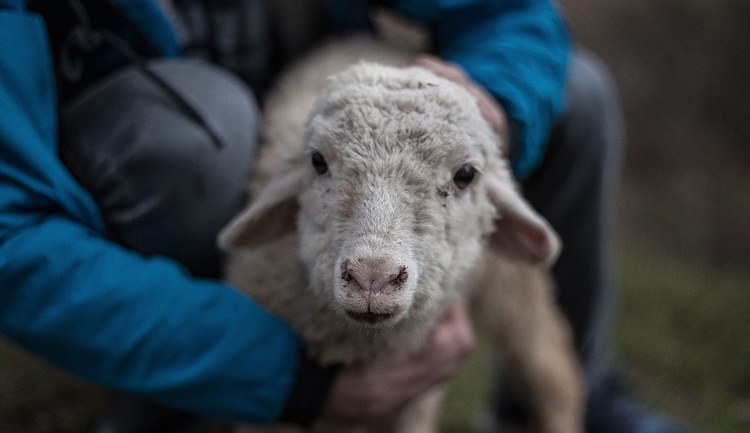
There were two men in a certain town. One was rich, and one was poor. The rich man owned a great many sheep and cattle. The poor man owned nothing but one little lamb he had bought. He raised that little lamb, and it grew up with his children. It ate from the man’s own plate and drank from his cup. He cuddled it in his arms like a baby daughter. One day a guest arrived at the home of the rich man. But instead of killing an animal from his own flock or herd, he took the poor man’s lamb and killed it and prepared it for his guest.
2 Samuel 12:1-4
Nothing in this story suggests the man’s affection for his lamb was abnormal or weird. This bond between human and animal was relatable—especially to David, a former shepherd. The treasured lamb wasn’t just livestock; it was family. And it was certainly a pet.
There’s no indication that the man should be seen as wrong to cuddle his pet lamb or grieve its loss. On the contrary, his devotion was honored. The story resonated with David, and later with readers of 2 Samuel, presumably because such relationships were common and natural in Hebrew culture, just as they are in ours today.
Sure, people are more central and valuable, but animals rank far above everything else in creation. (The silver medal isn’t bad!)
Can we go overboard in loving pets? Sure. We can turn them into idols. Idolatry can extend to anything we prioritize above God, including our families, careers, or hobbies. Loving animals appropriately means recognizing their place in God’s creation without elevating them above their intended role.
John Piper answered the question, “Do pets distract the Christian life?” by first acknowledging that, just like every other good thing in life—food, family, church, work, hobbies, sports, entertainment, cars, clothes, home improvement projects, exercise, and hanging out with friends, etc.—pets can become a distraction. But if we had no pets, he asks, “would that time. . . be devoted to more refreshing, more encouraging, more edifying, more loving, more God-glorifying tasks?” Not automatically.
Reflecting on his goldendoodle, Dusty, Piper said, “She loves people more than food. She overflows with affection without testing your character first. She is indomitably happy, rain or shine. She holds no grudges whatsoever, no matter how she is treated. Her youth at eight seems to be renewed like the eagle’s.” And he concedes, “Even with the Holy Spirit, I struggle to do those things.”
Piper concludes with an observation I have also found to be true: “Having a pet may fall into the category of God-saturated fascination and joy.”
A heart captivated by love for God does not say, “I will only love God—no one and nothing else.” It says, “Because I love God above all, I will better love people and animals and art and literature and music and sports and everything else good in life.”
Animals and people together glorify God. Gary Kurz observes, “[Animals] were so important to the habitat of mankind that God made them first so that they would be in place when people arrived.”
Many scholars believe Jesus is personified as Wisdom in Proverbs 8, where He says to His Father, “I was daily his delight, rejoicing before him always, rejoicing in his inhabited world and delighting in the children of man” (Proverbs 8:30-31, ESV).
Notice the phrase “rejoicing in his inhabited world,” which seems to be distinct from “delighting in the children of man.” The latter of course refers to Christ’s delight in humans, but the former would include His rejoicing over animals, who also populate the Earth He made. If Jesus can rejoice in animals, surely we can rejoice in them too, glimpsing our Lord’s originality and beauty. Loving animals should not be viewed as unspiritual. It can be profoundly spiritual. It all depends on whether God is primary or secondary in our hearts and minds.
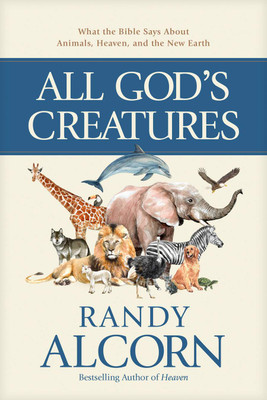
Excerpted from All God’s Creatures: What the Bible Says About Animals, Heaven, and the New Earth.